


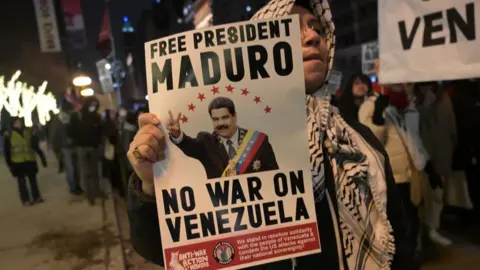
On Monday morning, a handcuffed, jumpsuit-clad Nicholas Maduro disembarked from a armed forces helicopter in Manhattan, surrounded by armed federal agents.
The Caracas chief had remained in a notorious federal detention center in Brooklyn, before authorities transferred him to a Manhattan courthouse to answer to criminal charges.
The chief law enforcement officer has said Maduro was taken to the US to "answer for his alleged crimes".
But legal scholars doubt the lawfulness of the government's actions, and argue the US may have breached international statutes governing the use of force. Under American law, however, the US's actions enter a juridical ambiguity that may nevertheless result in Maduro being tried, regardless of the events that brought him there.
The US insists its actions were lawful. The executive branch has charged Maduro of "narco-terrorism" and enabling the transport of "vast amounts" of cocaine to the US.
"All personnel involved conducted themselves with utmost professionalism, decisively, and in strict accordance with US law and established protocols," the Attorney General said in a official communication.
Maduro has consistently rejected US accusations that he runs an criminal narcotics enterprise, and in court in New York on Monday he pled of innocent.
International Law and Action Questions
While the accusations are related to drugs, the US prosecution of Maduro follows years of censure of his rule of Venezuela from the broader global community.
In 2020, UN investigators said Maduro's government had committed "serious breaches" that were human rights atrocities - and that the president and other senior figures were implicated. The US and some of its allies have also alleged Maduro of rigging elections, and withheld recognition of him as the legitimate president.
Maduro's purported connections to narco-trafficking organizations are the focus of this legal case, yet the US tactics in placing him in front of a US judge to answer these charges are also facing review.
Conducting a military operation in Venezuela and taking Maduro out of the country secretly was "completely illegal under global statutes," said a expert at a institution.
Scholars cited a host of concerns stemming from the US operation.
The UN Charter forbids members from threatening or using force against other countries. It allows for "self-defence if an armed attack occurs" but that threat must be looming, experts said. The other allowance occurs when the UN Security Council approves such an operation, which the US did not obtain before it proceeded in Venezuela.
Global jurisprudence would consider the narco-trafficking charges the US alleges against Maduro to be a police concern, experts say, not a armed aggression that might permit one country to take armed action against another.
In official remarks, the administration has described the mission as, in the words of the top diplomat, "basically a law enforcement function", rather than an act of war.
Precedent and US Legal Debate
Maduro has been formally charged on illicit narcotics allegations in the US since 2020; the Department of Justice has now issued a updated - or amended - charging document against the Venezuelan leader. The administration argues it is now carrying it out.
"The operation was carried out to aid an ongoing criminal prosecution tied to large-scale drug smuggling and connected charges that have fuelled violence, upended the area, and exacerbated the drug crisis claiming American lives," the AG said in her statement.
But since the operation, several jurists have said the US disregarded treaty obligations by taking Maduro out of Venezuela unilaterally.
"A country cannot enter another sovereign nation and arrest people," said an expert on international criminal law. "In the event that the US wants to arrest someone in another country, the established method to do that is extradition."
Even if an defendant is accused in America, "America has no authority to go around the world serving an detention order in the jurisdiction of other ," she said.
Maduro's lawyers in the Manhattan courtroom on Monday said they would contest the lawfulness of the US mission which took him from Caracas to New York.
There's also a long-running legal debate about whether presidents must adhere to the UN Charter. The US Constitution regards treaties the country signs to be the "supreme law of the land".
But there's a well-known case of a presidential administration contending it did not have to follow the charter.
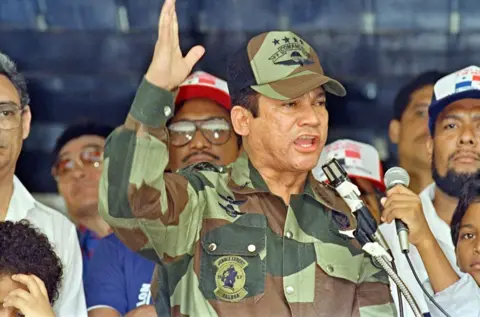
In 1989, the US government captured Panama's de facto ruler Manuel Noriega and took him to the US to answer drug trafficking charges.
An confidential legal opinion from the time contended that the president had the constitutional power to order the FBI to arrest individuals who flouted US law, "regardless of whether those actions breach traditional state practice" - including the UN Charter.
The draftsman of that memo, William Barr, was appointed the US attorney general and issued the first 2020 indictment against Maduro.
However, the memo's logic later came under criticism from jurists. US federal judges have not explicitly weighed in on the question.
Domestic War Powers and Jurisdiction
In the US, the issue of whether this action transgressed any US statutes is multifaceted.
The US Constitution gives Congress the authority to declare war, but puts the president in charge of the troops.
A Nixon-era law called the War Powers Resolution establishes constraints on the president's authority to use armed force. It compels the president to notify Congress before deploying US troops into foreign nations "in every possible instance," and inform Congress within 48 hours of committing troops.
The administration did not provide Congress a prior warning before the action in Venezuela "to ensure its success," a senior figure said.
However, several {presidents|commanders


